
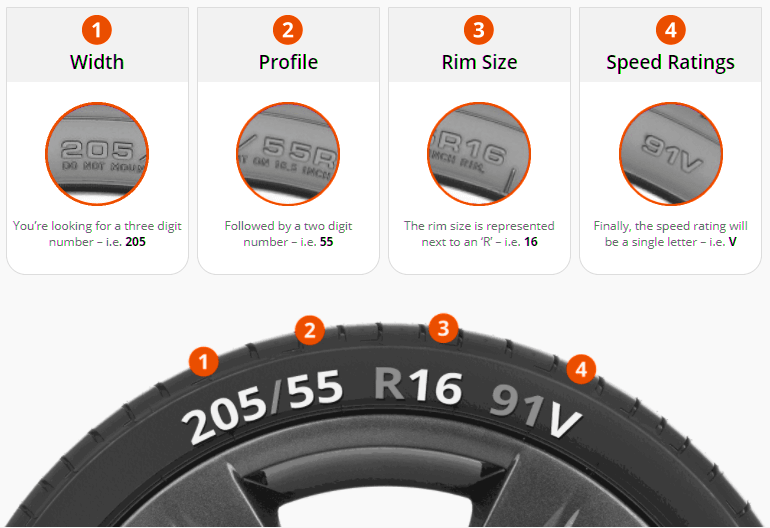
How do I read tyre size?
How do I read the date of production of a tyre?

What is Load Index / Speed Index on a tyre?
Next to the tyre size as seen above, the 91H at the end of the size represents the tyre’s service description. A service description identifies the tyre’s load index and speed rating.
The first two digits (91) represent the tyre’s load index and are followed by a single letter (H) identifying the tyre’s speed rating.
Load Index
205/55R16 91H – The load index (91) is the tyre size’s assigned numerical value used to compare relative load carrying capabilities. In the case of our example, the 91 identifies the tyre’s ability to carry approximately 615 kilograms.
The higher the tyre’s load index number, the greater its load carrying capacity.
A tire with a higher load index than that of the Original Equipment tyre indicates an increase in load capacity. A tyre with a load index equal to that of the Original Equipment tyre indicates an equivalent load capacity. A tyre with a lower load index than the Original Equipment tyre indicates the tyre does not equal the load capacity of the original.
The below chart indicates the various load index and the corresponding load

When looking at light truck (LT) or newer Special Trailer Service (ST) tyres, there are two load indexes branded on the sidewall, separated by a forward slash. Using an LT235/75R15 104/101S Load Range C tire as an example, the load index is 104/101. 104 corresponds to 900 kilograms, and 101 corresponds to 825 kilograms. So what is the true load carrying capacity of the tyre? The answer changes depending on the situation in which the tyre is being used.
Since LT tires are commonly used on trucks with dual rear wheels, they are branded with two load indexes. The first number indicates the load carrying capacity if the tyre is installed on a truck with a single-wheel rear axle, and the second number applies when the tyre is used in a dual rear application.
Though it may seem counterintuitive that a tyre is rated to carry less weight when working in tandem with another tyre in the dual pair, the purpose is to build in additional reserve capacity should one of the two tyres fail, leaving the sole remaining tyre to carry the load normally handled by two tyres.
Speed Rating
Speed ratings were established to match the speed capability of tyres with the top speed capability of the vehicles to which they are applied. Speed ratings are established in kilometres per hour and subsequently converted to miles per hour. Despite the tyre manufacturers’ ability to manufacture tyres capable of high speeds, none of them recommend the use of their products more than legal speed limits. The maximum operating speed of a vehicle must be limited to the lowest speed rated tyre on the vehicle.
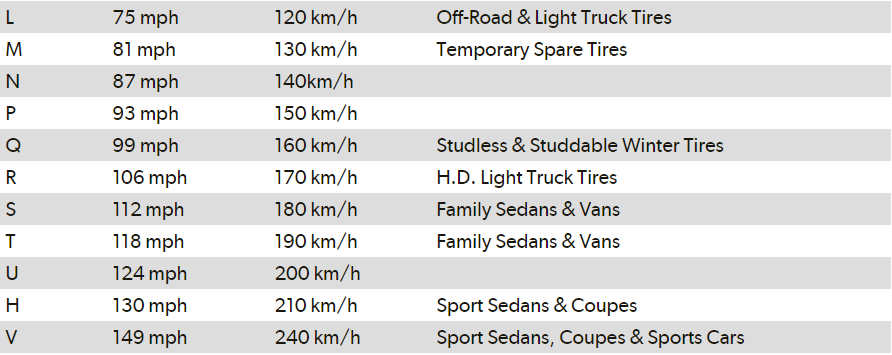
Speed ratings are based on laboratory tests where the tyre is pressed against a large diameter metal drum to reflect its appropriate load and run at ever increasing speeds (in 6.2 mph steps in 10 minute increments) until the tyre’s required speed has been met.
It is important to note that speed ratings only apply to tyres that have not been damaged, altered, under-inflated or overloaded. Additionally, most tyre manufacturers maintain that a tyre that has been cut or punctured no longer retains the tyre manufacturer’s original speed rating, even after being repaired because the tyre manufacturer can’t control the quality of the repair.